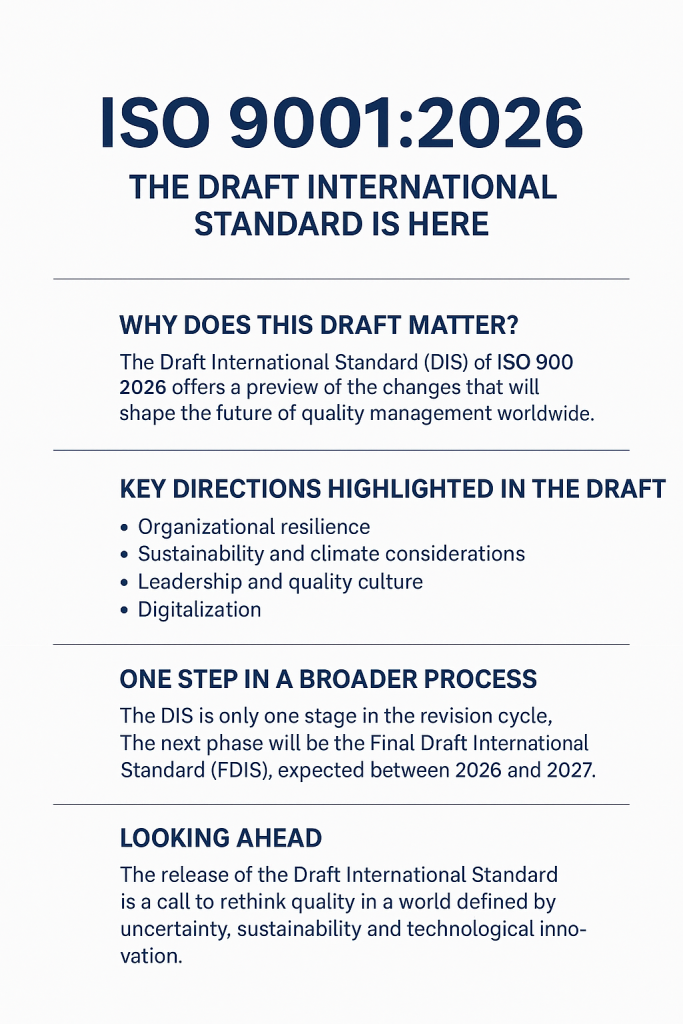

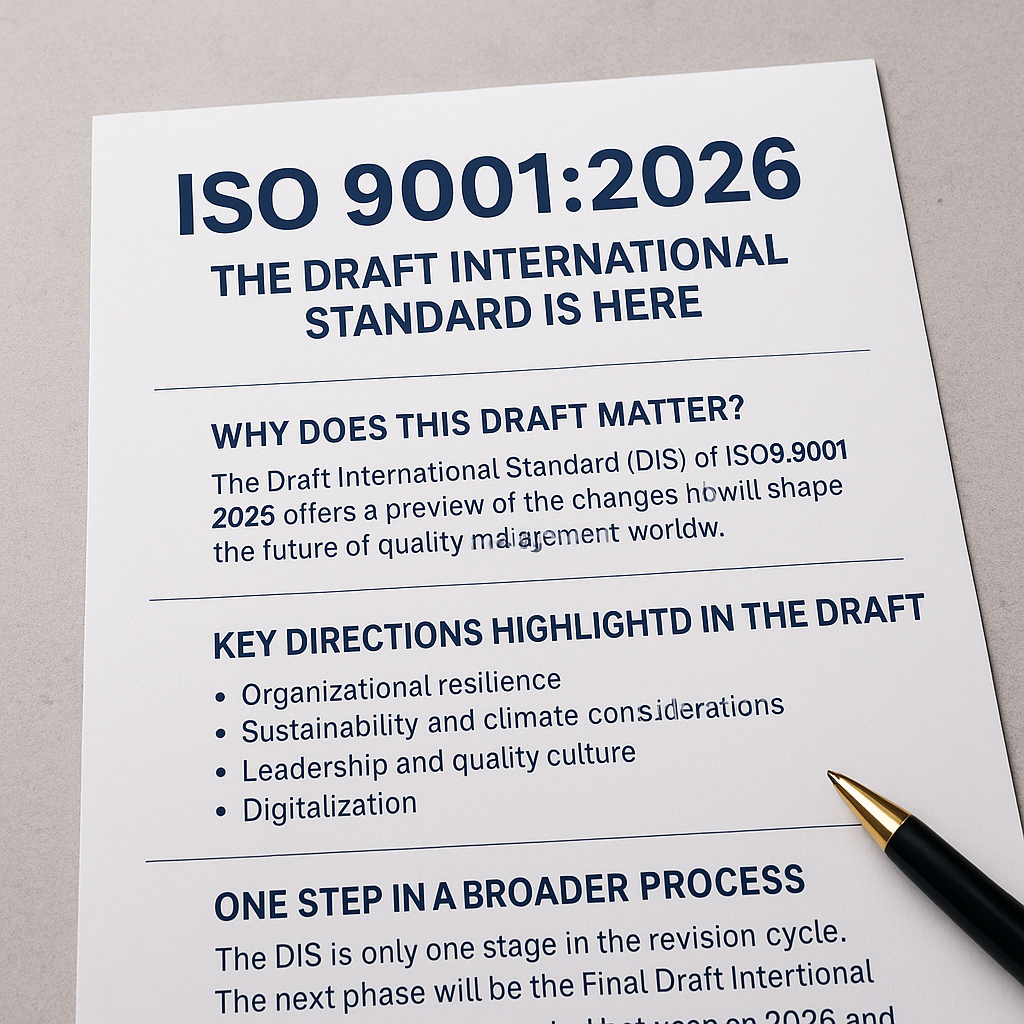
ISO 9001, the world’s most widely adopted quality management standard, is undergoing a major transformation. Its revision process has reached a significant milestone with the release of the Draft International Standard (DIS) for the 2026 edition. While this draft is not the final text, it offers a valuable preview of the changes that will shape the future of quality management worldwide.
Far from being just a technical step, the DIS creates a space for dialogue between companies, certification bodies, and experts. It is a moment when organizations can study the document, analyze its potential impact, and most importantly, contribute by submitting comments and suggestions. This collaborative approach ensures that ISO 9001 remains relevant and closely aligned with the realities of an ever-changing business environment.
Why does this draft matter?
For companies, the DIS represents an opportunity to look ahead in time. Reviewing it allows them to anticipate the adjustments that will very likely become mandatory once the final standard is published. Instead of waiting until the last minute, organizations can begin now to assess gaps, train their teams, and adjust their processes. In addition, this draft provides clarity on the direction the standard is taking: a stronger focus on organizational resilience, the integration of sustainability and climate change, the strengthening of leadership and quality culture, and adaptation to an environment increasingly shaped by digitalization.
What does DIS mean for organizations?
The international draft is not the final version, but it does provide a good preview of the expected changes.
Permite a las organizaciones:
- Anticipating the adjustments que probablemente sean obligatorios en 2026.
- Analyze impacts in their quality management systems.
- Participate in the process, by submitting comments through the official standardization channels.
- Prepare the work team, avoiding improvisations when the final rule comes into force.
One step in a broader process
The DIS is only one stage of the review cycle. Next will come the FDIS (Final Draft International Standard), which will incorporate the feedback received, and finally the official publication of the new ISO 9001:2026, scheduled between 2026 and 2027. This timeline gives companies a window of preparation—provided they choose to take advantage of it starting now.
Looking ahead
The release of the international draft standard should not be viewed solely as a regulatory change. Rather, it is an invitation to rethink how we understand quality in a world where uncertainty, sustainability, and technological innovation are key drivers.
Those who start working with the DIS today will not only be ready for the transition but will also be able to turn this process into a competitive advantage, demonstrating to the market that they are prepared, resilient organizations aligned with the demands of the future.