
Artificial intelligence is no longer a technology of the future. It is making decisions, automating processes, analyzing data, and transforming entire industries in real time. Today, companies of all sizes are using AI to optimize operations, improve customer service, detect risks, and accelerate productivity. But as the speed of adoption increases, a critical question arises: Who ensures that all that intelligence operates safely, ethically, and reliably?
Because AI doesn't just bring opportunities. It also introduces new challenges: privacy, bias, cybersecurity, automated decision-making, and loss of operational control. And this is where international standards begin to play a crucial role.
Unstructured AI can become a risk
Many organizations are rapidly implementing artificial intelligence, but without a clear management strategy. The problem isn't using AI; the real risk is using it without control.
Poorly supervised systems can lead to:
- Inconsistent decisions.
- Integrate information security controls.
- Biases in automated processes.
- Lack of traceability and transparency.
- Technological dependence without adequate governance.
Innovation without structure can accelerate problems as quickly as it accelerates results. That's why the future won't belong solely to companies that adopt AI… but to those that know how to manage it correctly.
The rules: the invisible framework behind trust
Every major technological transformation needs a solid foundation. In the age of artificial intelligence, that foundation will be international standards.
Organizations need systems that allow:
- Managing technological risks.
- Protect the information.
- Ensure transparency.
- Maintain control over automated processes.
- Aligning innovation with business objectives.
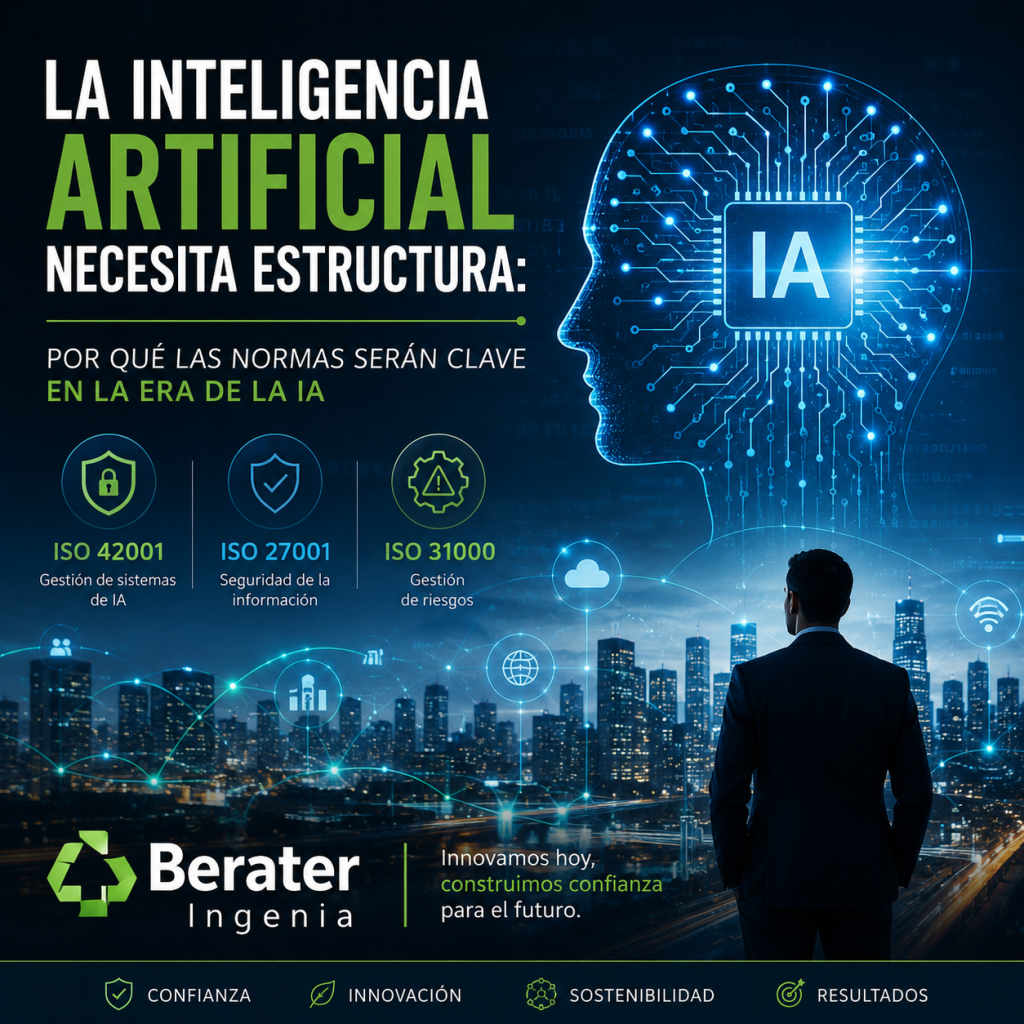
This is where standards such as ISO 42001, ISO 27001 and ISO 31000 begin to become strategic tools for companies seeking to innovate responsibly.
ISO 42001: the new benchmark for managing AI
The emergence of ISO 42001 marks a key moment in business evolution. This standard provides a framework for managing artificial intelligence systems in a way that is: Secure, Ethical, Transparent, and Controlled. It's not about limiting innovation. It's about building trust around it. Because as AI is integrated into critical decisions, companies will need to demonstrate that their systems are reliable, auditable, and aligned with responsible principles.
The real challenge is not technological… it's cultural.
Implementing artificial intelligence not only transforms processes, it transforms organizational cultures.
Companies need to learn to coexist with intelligent systems without losing:
- human leadership
- critical thinking,
- business ethics
- supervisory capacity.
AI does not replace the need for strategic direction.
It makes it even more important.
That's why the most successful organizations won't necessarily be the most automated… but rather those that manage to balance innovation with responsibility. In the coming years, many companies will have access to similar artificial intelligence tools. The real difference won't just be who uses AI first… but who can generate the most trust around it. Customers, investors, and partners will begin to demand: transparency, security, compliance, technology governance, and digital responsibility. And international standards will be the language that allows us to demonstrate this.
Innovate with structure
At Berater Ingenia, we understand that digital transformation isn't just about implementing technology. It's about building robust systems where innovation, security, and sustainability can thrive together. Because artificial intelligence has the potential to transform entire companies… but only when there's a structure in place to guide it effectively. The next generation of companies won't be defined solely by how much artificial intelligence they use.
It will be defined by:
- how they manage it,
- how do they protect the information,
- how do they control the risks
- and how they build trust in an increasingly automated environment.
Because the true future of AI doesn't depend solely on technology… it depends on the human capacity to use it responsibly.