
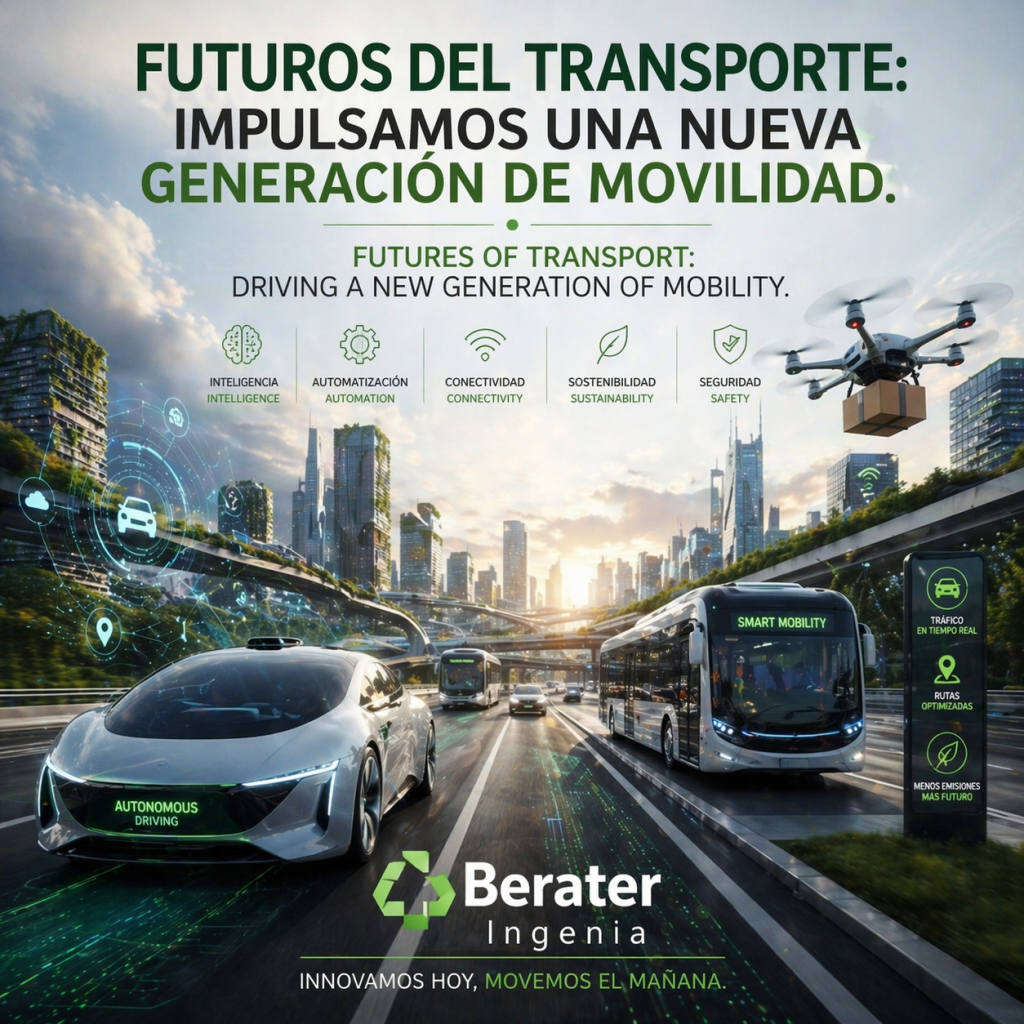
Mobility is changing faster than at any other time in history. Vehicles are no longer just driven… they are beginning to think. Cities are no longer just growing… they are beginning to respond. Behind this transformation lies a powerful convergence: intelligence, automation, and connectivity working in unison to redefine how people and goods move around the world. What once took decades now evolves in a matter of years—or even months—and the result is not just faster journeys, but safer, more resilient, and more sustainable systems by design.
Mobility as an intelligent system
Imagine a city as a living organism. Roads are its arteries, vehicles its constant flow… and data, its nervous system. Intelligent transportation systems transform traditional networks into predictive environments, where information flows in real time, allowing for proactive decisions before problems arise. Traffic adjusts dynamically, routes are automatically optimized, and systems learn from their surroundings.
The result is clear:
Less congestion, fewer emissions and greater operational efficiency
Cities designed for people
The new mobility isn't about vehicles… it's about people. Smart cities integrate public transportation, shared mobility, pedestrian routes, and digital solutions into a seamless experience, where every journey is simpler, cleaner, and more intuitive. But this progress is not without its challenges; factors such as regulation, investment, and cybersecurity will determine how quickly this transformation can scale.
Because the future doesn't just depend on technology... it depends on how we decide to implement it.
When autonomy takes control
Autonomous vehicles are no longer science fiction. Today they are being tested in real-world trials, redefining what it means to drive.
The potential is enormous:
- Accident Reduction
- Traffic optimization
- Inclusion of new users in mobility
But it also raises key questions:
Who is responsible? How is it regulated? How is trust built?
For businesses, this marks a turning point. Manufacturers are becoming software developers, and logistics is evolving into fully digital ecosystems.
Resilience as the new logistics standard
For businesses, this marks a turning point. Manufacturers are becoming software developers, and logistics is evolving into fully digital ecosystems.
- Detect risks before they occur
- Adjust operations in real time
- Avoid cascading interruptions
Resilience is no longer an add-on… it's the new standard.
Standards: the invisible foundation of the future of mobility
All this innovation has one thing in common: the need for trust.
Trust that the systems will work.
Trust that the data will be secure.
Trust that the technology will be reliable.
This is where international standards come in:
- ISO 21217: establishes the communication architecture in intelligent transport systems.
- ISO 34503: defines test scenarios for autonomous vehicles.
- ISO 23354: guarantees end-to-end visibility in the logistics chain.
- ISO 21384-3: regulates the safe operation of drones.
These standards not only support innovation… they make it possible.
From innovation to strategy
The future of transportation isn't just about technology. It's about integrating that technology in a structured, safe way, aligned with business objectives. At Berater Ingenia, we help organizations translate these trends into robust management systems, where innovation becomes measurable results. Because moving faster isn't enough… it must be done with direction, control, and purpose.
The future is in motion
The mobility of the future is already here. More connected, smarter, more sustainable. But its true value lies not in speed, but in the trust it inspires. Because in a world in constant motion, the companies that will lead will not be those that simply adopt technology… they will be those that know how to structure it, manage it, and turn it into a competitive advantage.