

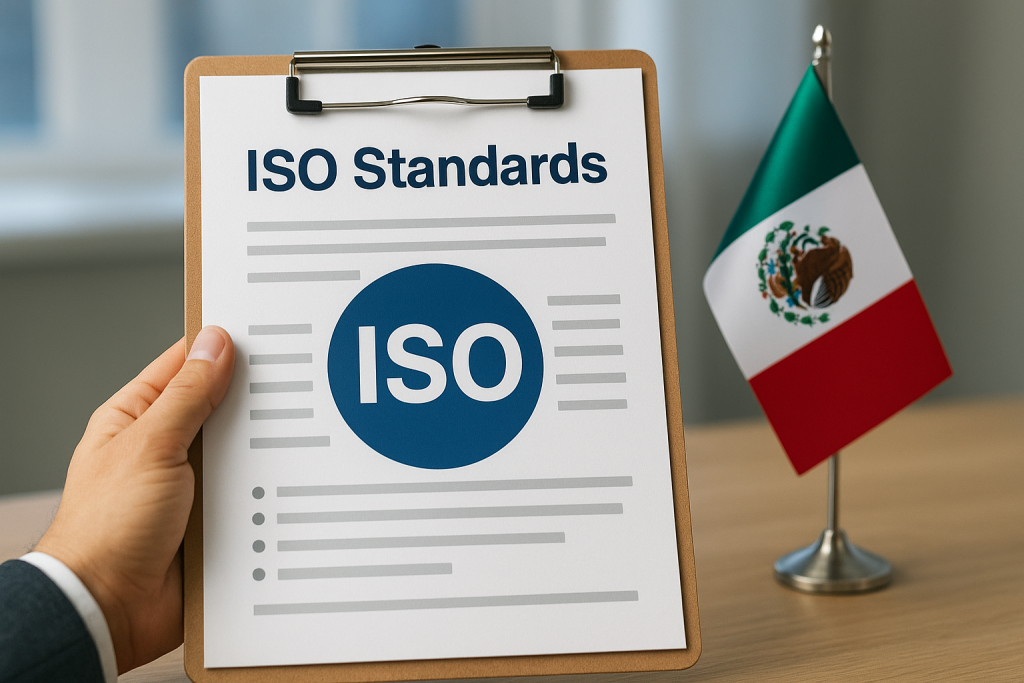
In an increasingly competitive and globalized world, international standards have become a key factor for business growth. Among them, ISO standards (International Organization for Standardization) hold a central place. Mexico is no exception: adopting these standards has strengthened the country’s position in international markets, increased consumer trust, and raised the quality of production processes.
Why are ISO standards important in Mexico?
ISO standards are globally recognized guidelines that establish clear criteria for quality, safety, sustainability, and efficiency. In Mexico, their importance can be seen in several ways:
- International competitiveness: companies that comply with ISO standards can compete on equal terms in global markets
- Facilitation of exports: many countries require ISO-certified products and services to enter their markets.
- Trust and reputation: certifications demonstrate commitment to quality, safety, and environmental responsibility, generating greater trust among clients and investors.
- Regulatory compliance: in sectors such as healthcare, food, or energy, ISO standards align with national and international regulations, preventing penalties and ensuring best practices.
- Continuous improvement: since ISO standards are based on ongoing process review, they encourage innovation, reduce waste, and help optimize resources.
How are ISO standards managed in Mexico?
Although ISO standards originate in an international context, Mexico has its own system to adopt and manage them. This process involves several key organizations:
- Secretary of Economy – Through the General Directorate of Standards (DGN) it coordinates standardization in the country.
- National Standardization Organizations (ONN) – Institutions such as IMNC, ANCE, NYCE or NORMEX translate and adapt ISO standards to Mexican Standards (NMX).
- Mexican Accreditation Entity (EMA) – Responsible for accrediting certifying bodies to ensure that certificates issued in Mexico are valid internationally.
In this way, an ISO standard can become a Mexican Standard (NMX) for voluntary adoption or, in some cases, an Official Mexican Standard (NOM) when compliance is mandatory.
Mexico’s relationship with ISO standards
More than just technical guidelines, ISO standards represent for Mexico a tool for integration into global trade and innovation. By adopting these standards, Mexican companies speak the same “language of quality” as businesses in Europe, Asia, or the United States.
This not only opens doors for exports but also fosters the professionalization of small and medium-sized enterprises, builds greater investor confidence, and boosts national competitiveness. In short, Mexico uses ISO standards as a bridge that connects local quality with international benchmarks.
Clousure
The importance of ISO standards in Mexico lies in their ability to enhance competitiveness, trust, and efficiency within organizations. Thanks to the joint work of national institutions and international bodies, the country remains aligned with global best practices, making ISO standards a strategic driver for economic development and innovation.